Choosing a handgun or expanding a collection of accessories is only one aspect of responsible gun ownership. It entails comprehending the design of products, being aware of their intended use, keeping equipment properly, protecting firearms from unwanted access, abiding by applicable regulations, and making judgements about purchases based on trustworthy information.
The variety of handgun accessories available online might occasionally feel daunting to customers looking at Gun Pro. A variety of sight systems, magazines, storage devices, maintenance supplies, and other accessories, each with unique specifications and purposes, may be listed as products.
Customers can avoid needless or inappropriate products and make better judgements by being aware of these categories before making a purchase.
This guide’s goal is to provide responsible owners with an explanation of handgun accessories. The essay examines how consumers can assess product purpose, compatibility, construction, documentation, maintenance requirements, storage considerations, and legal obligations rather than just adding additional equipment.
An owner’s configuration should clearly justify the use of a high-quality attachment. Additionally, it must be suitable for the relevant firearm, backed by trustworthy manufacturer data, and utilised in accordance with applicable regulations and guidelines.
What Are Pistol Accessories?
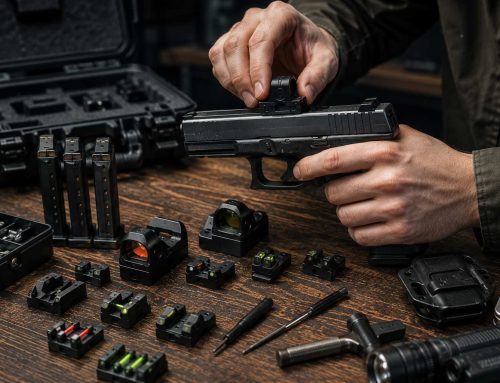
Other goods related to owning a handgun are pistol accessories. They can be used for a variety of tasks, such as organization, storage, transportation, maintenance, and other equipment-related requirements.
Since the phrase is broad, not all accessories serve the same purpose. While some goods are made to facilitate safe storage, others are meant to handle related objects or transport equipment.
Additionally, customers could come across accessories that are directly related to firearm parts. Model-specific specifications may apply to certain products, and further investigation may be necessary prior to purchase.
Customers should refrain from treating gun attachments as interchangeable due to this variance. Every product should be assessed based on the manufacturer’s specs and intended use.
Why Responsible Accessory Shopping Matters
Browsing a wide range of products is made simple via online shopping. Convenience, meanwhile, can often lead to impulsive purchases.
A conscientious consumer should first determine the necessity that an item is meant to fulfil. Buying the goods could add needless cost or complexity if the objective is unclear.
Customers can ask more insightful queries if they are aware of an accessory. Rather than only asking if a product is “good,” consumers might think about if it is compatible, well-made, backed up by documentation, and suited for their situation.
Because technical and regulatory requirements can differ, this method is particularly helpful when purchasing products related to firearms.
The Main Purpose of an Accessory
Prior to comparing products, ascertain the purpose of the accessory.
The storage purpose of an accessory should be taken into consideration when evaluating it. The intended transportation function and relevant rules should be taken into consideration while evaluating a transportation product. The manufacturer’s directions should be followed when reviewing maintenance equipment.
The process of shopping can be considerably simplified by using this purpose-first strategy.
Additionally, it assists consumers in differentiating between things that are essentially optional adds and those that truly meet ownership needs.
It is not necessary for a responsible setup to include every item that is available. Rather, every product need to have a distinct and intelligible function.
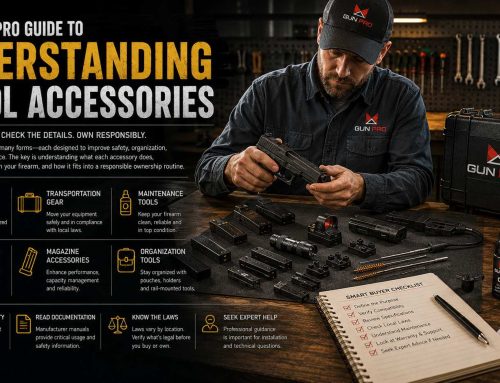
Understanding Different Accessory Categories
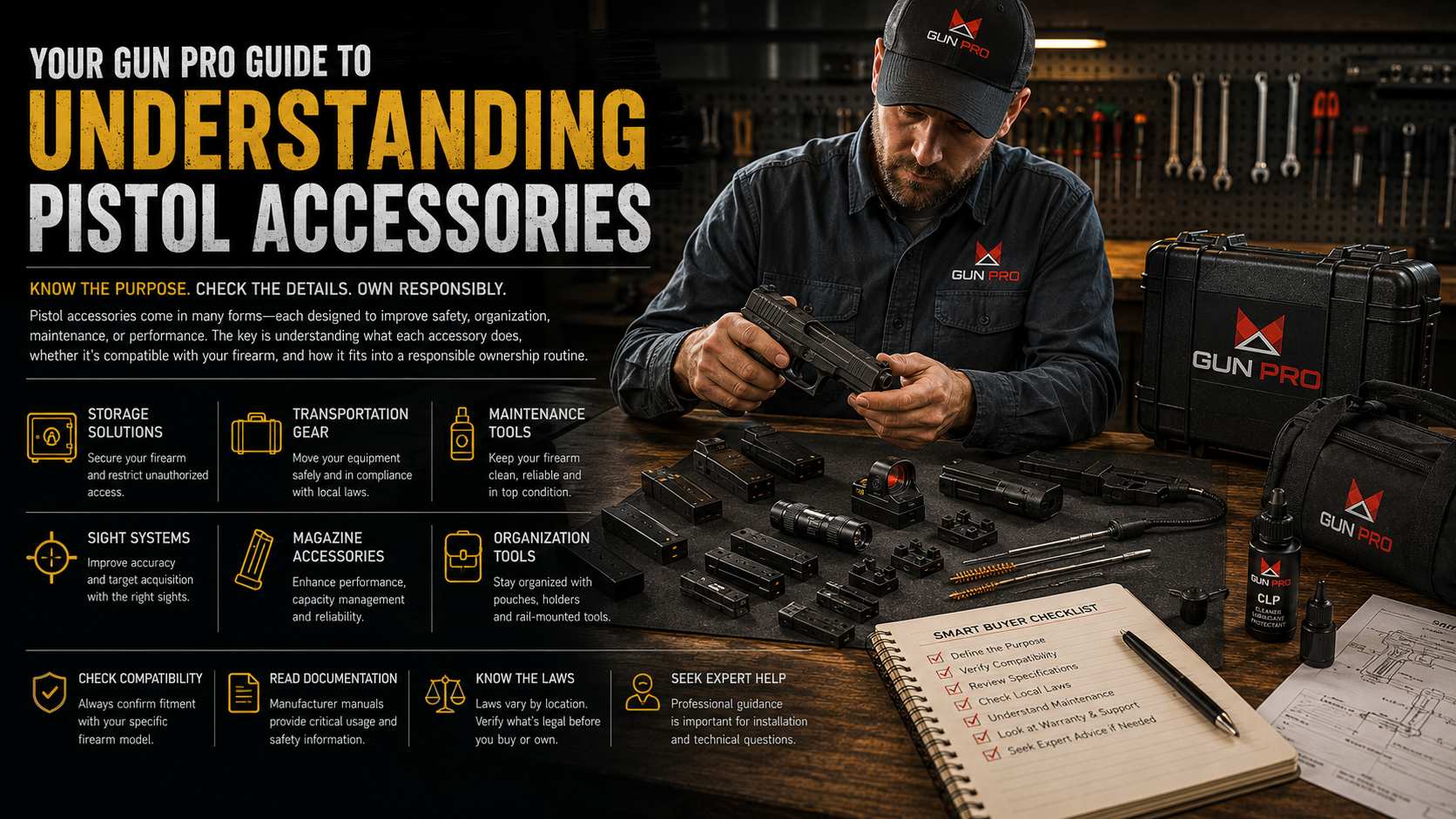
Accessories for pistols fall into a number of general types. Depending on the manufacturer, retailer, and jurisdiction, several categories will be offered.
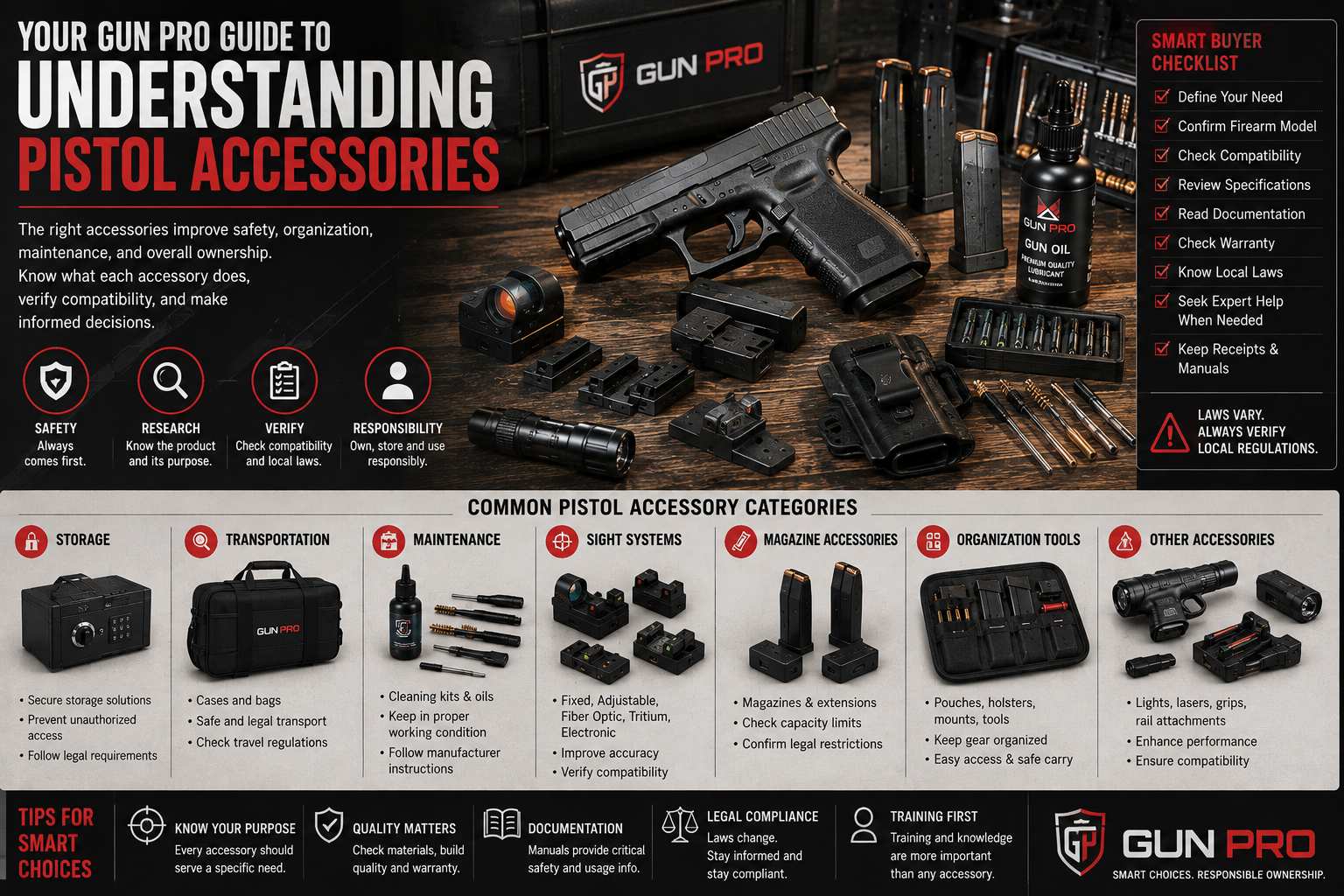
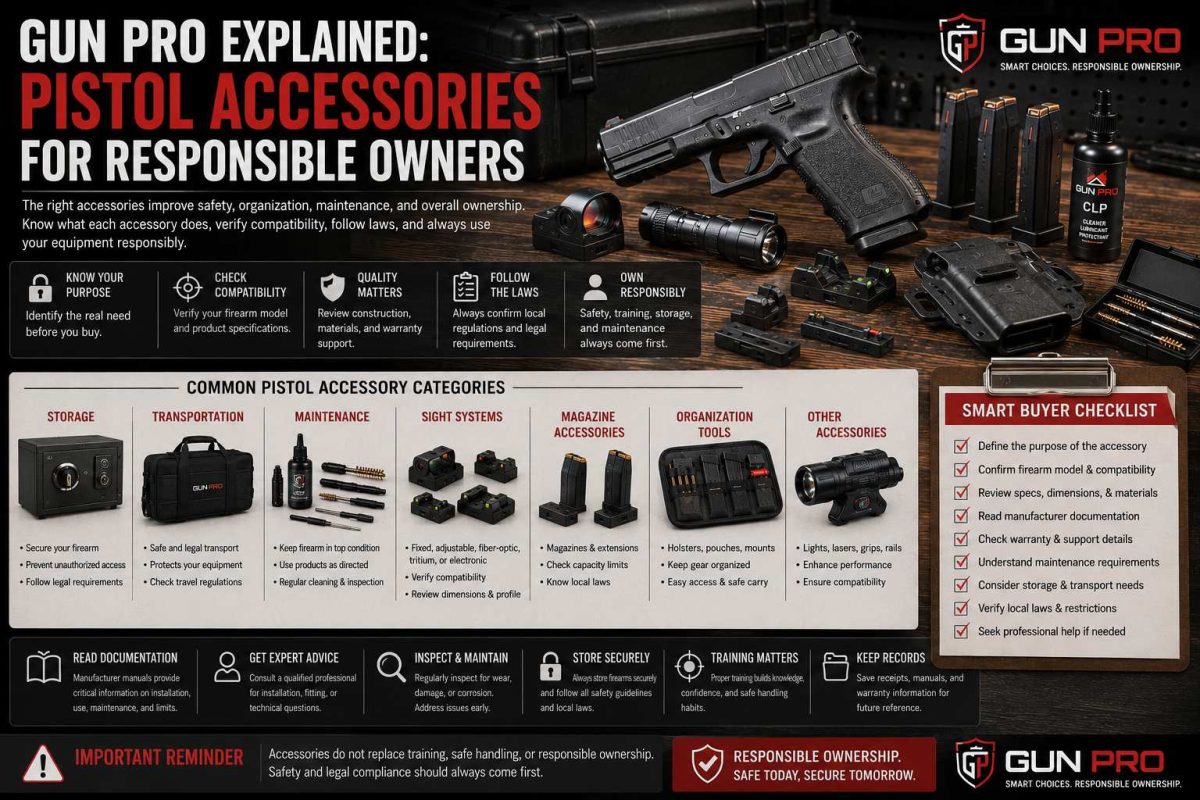
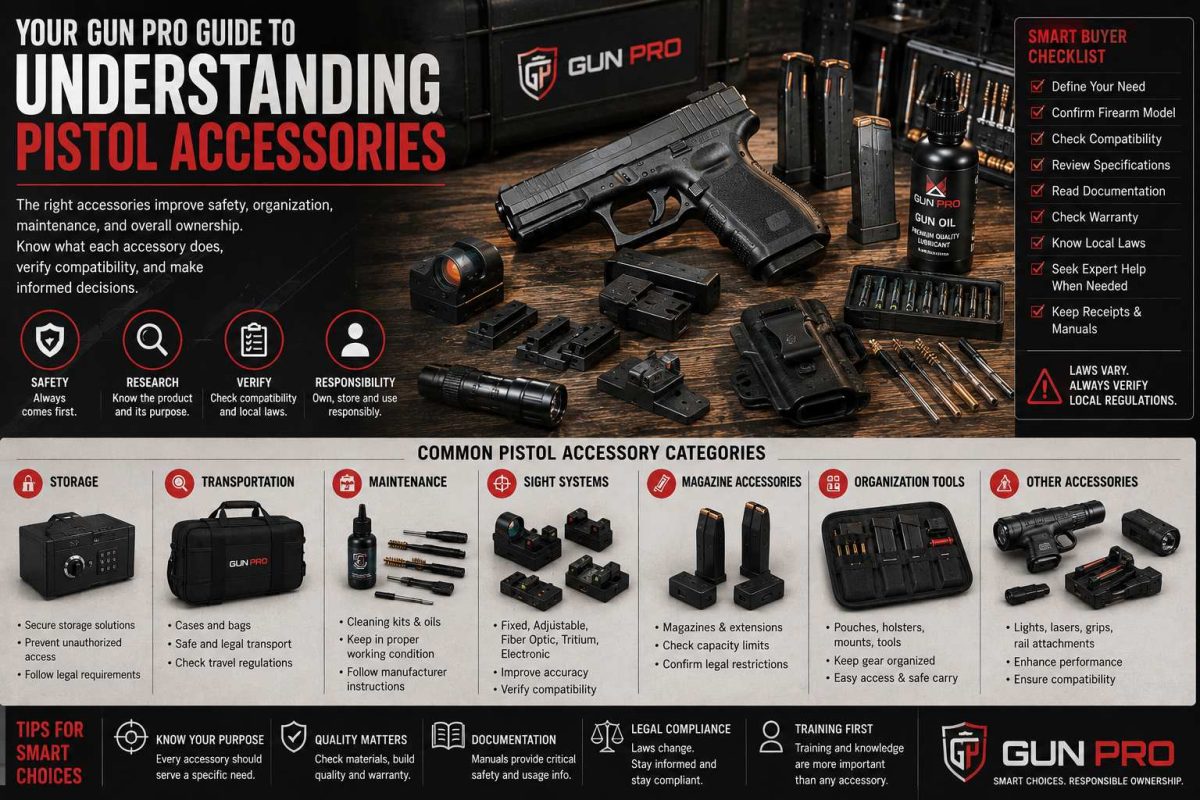
Storage items, transportation equipment, maintenance-related products, sight-related accessories, magazines, organisational products, and other firearm-related equipment are typical places that buyers might come across.
Different factors must be taken into account for each category.
For instance, storage equipment must take security and access control into account, whereas sight items may need to take firearm-specific compatibility and dimensions into account. Products connected to magazines may be subject to jurisdiction-specific capacity limitations.
Customers have a better basis for comparison when they comprehend the category before looking at specific products.
Storage Accessories and Responsible Ownership
One of the most significant obligations that come with owning a handgun is secure storage.
In houses where kids, guests, or other people can be present, storage devices can help prevent unwanted entry.
Consumers should choose storage options according to their needs and relevant circumstances. For any storage product they buy, they should also adhere to the manufacturer’s guidelines.
A safe storage habit cannot be established just by possessing a storage accessory. Consistent use of their equipment and knowledge of local regulations are prerequisites for responsible owners.
Storage should not be viewed as an unnecessary afterthought while investigating Gun Pro items, but rather as a crucial component of responsible ownership.
Transportation Equipment
Another area where careful planning is crucial is transportation.
Laws pertaining to the transportation of firearms might vary greatly between states. Depending on the location, destination, mode of transportation, and other factors, requirements may change.
Before transporting firearms or related equipment, customers should confirm the current regulations.
Although having a specific case or container does not automatically make transportation legal, transportation accessories can help with security and organization.
Customers should therefore check official information before to travel, particularly when crossing national, state, or provincial borders.
Understanding Sight-Related Accessories
Another category that consumers may come across while perusing handgun accessories is sight-related products.
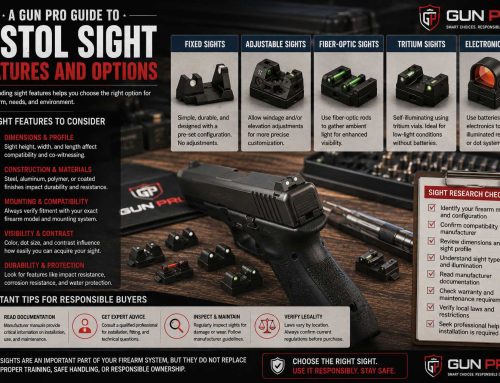
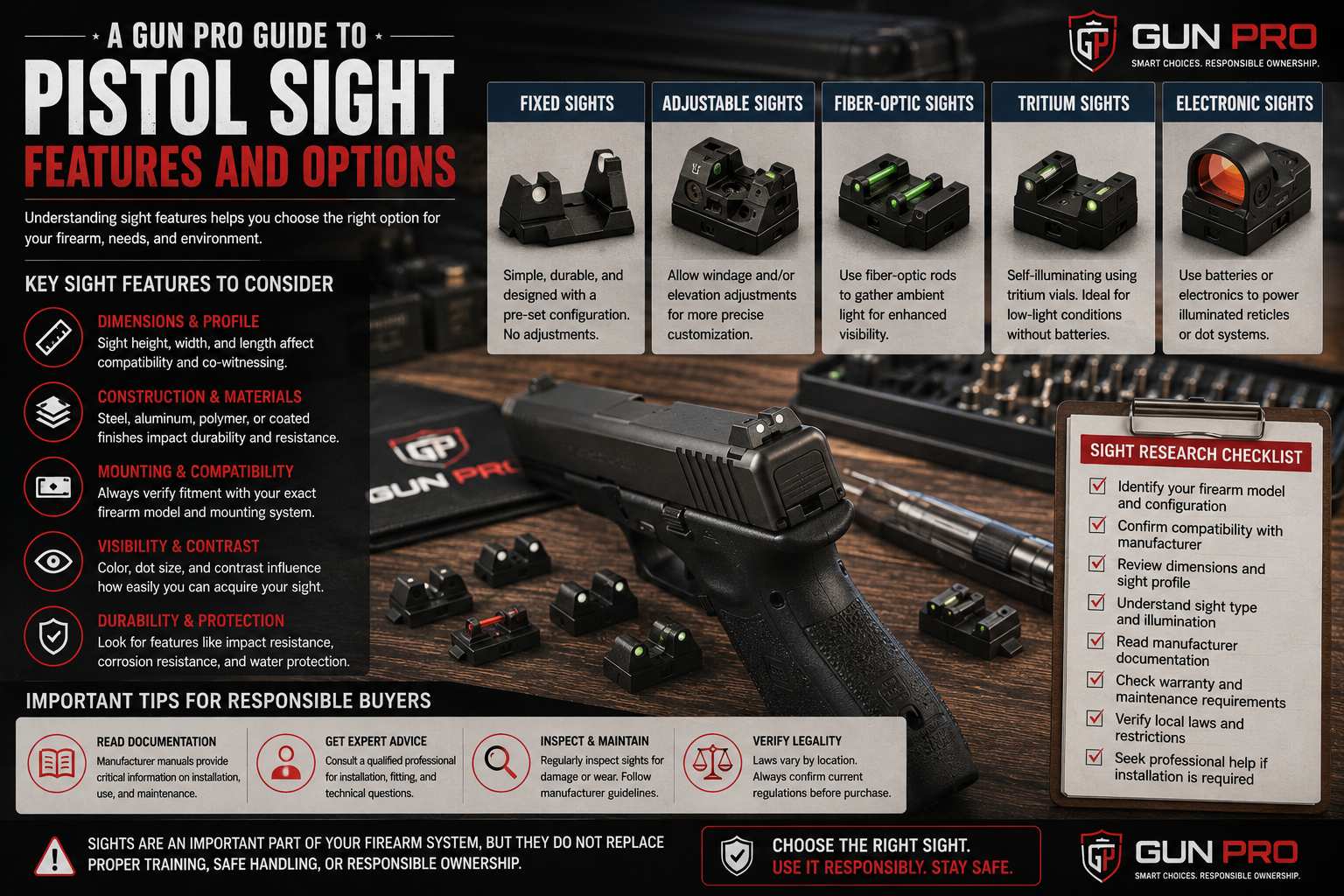
The design, construction, proportions, and technology of various sight items can differ. Fixed, adjustable, fiber-optic, tritium-based, and electronic solutions are examples of common categories.
Compatibility is the most crucial factor for conscientious consumers.
A sight that works with one type of rifle might not work with another. Before making a purchase, customers should confirm the precise model of the firearm and refer to the manufacturer’s paperwork.
Professional assistance may be necessary if installation or fitting requires technical firearm work.
Magazine-Related Accessories
Firearm accessories catalogues may also include items connected to magazines.
Compatibility information, product specs, structure, and any related regulatory requirements should all be carefully considered by customers.
Laws can alter over time, and magazine capacity restrictions can vary significantly between countries.
Customers should therefore confirm the most recent local regulations before acquiring or owning magazine-related goods.
Retail availability should not be interpreted as evidence that a specific product is legal for every consumer.
Maintenance-Related Products
Equipment maintenance is another aspect of responsible ownership.
When used in accordance with manufacturer instructions, maintenance-related goods can enhance general care. Instead of thinking that one general procedure applies to all products, consumers should examine the individual maintenance requirements related to their handgun and accessories.
A professional inspection might be necessary if an attachment gets broken, flawed, or otherwise dubious.
Unsupported repairs or modifications should be avoided by owners, especially if they involve unknown weapon parts.
For product-specific maintenance information, manufacturer documentation should continue to be the major source.
Understanding Product Compatibility
One of the most crucial considerations when buying handgun attachments is compatibility.
Different dimensions, combinations, mounting systems, and model-specific designs can be used by firearm makers. Even visually comparable products could not be interchangeable.
Customers should determine the precise model of firearm and match it with the compatibility data provided by the manufacturer.
Product photos shouldn’t be used as evidence of compatibility.
Before making a purchase, consumers should get in touch with the manufacturer, retailer, or other competent expert if the specifications are unclear.
Unnecessary returns and inappropriate orders can be avoided with one easy step.
Construction and Material Quality
Documented features, not just looks, should be the basis for evaluating high-quality accessories.
Depending on the product category, manufacturers may employ metals, polymers, textiles, optical materials, protective coatings, or electronic components.
The manufacturer’s description of construction and intended use should be reviewed by customers.
Better quality is not always indicated by a higher price, and bad quality is not always indicated by a lower price.
Instead, buyers should take into account the manufacturer’s reputation, compatibility, intended use, construction, paperwork, and warranty support.
Why Manufacturer Documentation Matters
Important details that aren’t usually present in a retailer’s product description can be found in manufacturer documentation.
Compatibility charts, product measurements, maintenance guidelines, installation details, warranty conditions, restrictions, and other details may be included.
Before utilising an attachment, customers should examine these materials, and they should keep them accessible after purchase.
Customers should ask for clarification rather than forming assumptions if a retailer’s product description seems ambiguous or contradictory with manufacturer documentation.
Product-specific material is typically more helpful than general recommendations for firearm-related products.
Quality Should Mean More Than Price
Price is sometimes one of the first things that buyers look for when looking for high-quality handgun accessories. However, an accessory’s suitability is not just determined by its cost.
Examining the product as a whole is a superior strategy.
Take into account the design, features, compatibility details, manufacturer assistance, warranty coverage, intended use, and upkeep needs.
Instead of only selecting the priciest alternative, this method enables customers to compare products based on relevant information.
In the end, quality should refer to a product’s suitability for its intended use, good design, documentation, and manufacturer support.
Professional Assistance for Technical Questions
Technical installation or fitting may be required for some accessories.
Instead of trying unknown firearm-related work, customers who lack the requisite expertise or experience should think about consulting a certified professional.
Questions concerning manufacturer requirements, compatibility, and fitting can be answered by professionals.
Because a product seems simple, owners should never assume that an accessory can be fitted.
Unsupported alterations should be avoided, and manufacturer instructions should always be examined.
A key component of responsible ownership is knowing when to seek professional help.
Maintenance and Equipment Inspection
It is important for owners to monitor the state of their accessories.
Additional inspection may be necessary if there are indicators like obvious damage, excessive wear, corrosion, cracks, or other irregularities.
Customers should adhere to the inspection and maintenance guidelines provided by the manufacturer.
It is not appropriate to assume that a product is fit for continuous use if it seems damaged or malfunctioning.
Long-term equipment management can be facilitated by keeping purchase records, warranty information, product paperwork, and manuals organised.
Responsible Shopping at Gun Pro
Customers looking to explore firearm accessories can do so online at Gun Pro.
When perusing the website, customers can start by selecting the category that best suits their requirements before reviewing the details of specific products.
But reading a product’s title isn’t the only part of smart shopping. When available, customers should review manufacturer literature, warranty details, compatibility information, and specs.
Before making a purchase, consumers should enquire about a product’s suitability or intended use.
This strategy can lessen the possibility of inappropriate orders while assisting clients in making better judgements.
Evaluating Customer Reviews
When doing product research, customer reviews can be helpful, but they must be carefully considered.
A review does not necessarily prove that a product is appropriate for every firearm, owner, or situation; rather, it recounts an individual’s experience.
Reviews can be used to find recurrent issues or questions, but manufacturer documentation and relevant expert advice should be the foundation for significant technical choices.
Broader context can be obtained by combining manufacturer data, user reviews, and product specifications.
Understanding Warranty Coverage
Another helpful consideration when assessing accessories is warranty information.
Consumers should be aware of the manufacturer’s coverage, how long it lasts, and any terms that might influence a warranty claim.
Maintaining purchase receipts and supporting paperwork can make future customer care encounters easier.
Additionally, a clear warranty policy might help buyers better comprehend the manufacturer’s post-purchase service.
Building a Simple, Responsible Setup
A sizable collection of accessories is not necessary for responsible ownership.
A straightforward structure is frequently simpler to manage, arrange, and comprehend.
Ask if an accessory truly fills a need before making a purchase. If the answer is not clear, more investigation could be necessary.
This way of thinking can make equipment management simple while preventing wasteful spending.
Instead of accumulating goods just because they are available, the objective should be to uphold a responsible ownership environment.
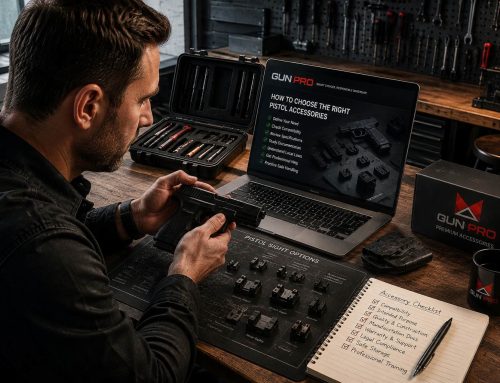
A Responsible Accessory Buying Checklist
Before purchasing pistol accessories online, shoppers can use this checklist:
- Determine the accessory’s precise function.
- Verify the precise model of the firearm and any other details.
- Use the manufacturer’s documentation to confirm compatibility.
- Examine the product’s constraints, materials, dimensions, and intended usage.
- Examine the maintenance, care, and warranty details.
- When applicable, take into account the needs for safe storage and transit.
- Before making a purchase, confirm all applicable rules and regulations.
- When it comes to technical installation or fitting, get expert professional help.
Following a structured process can make online shopping more deliberate and reduce unnecessary purchases.
Legal Compliance and Responsible Ownership
Laws pertaining to firearms might differ significantly between states.
Ownership, acquisition, storage, transportation, magazine capacity, accessories, and other aspects of firearms may be subject to regulations.
Customers should confirm up-to-date information via the relevant official sources because these regulations are subject to change.
Not every consumer is legally allowed to buy or possess a product just because it is featured on an e-commerce website.
Customers should speak with a certified legal professional or the appropriate authority where legal requirements are unclear.
Why Safety Should Come First
Basic safety procedures should never be replaced by accessories.
Safe handling, secure storage, suitable transportation, maintenance awareness, and relevant legislation should all be understood by responsible owners.
Professional training can also be beneficial, especially for those who have never owned a firearm before or are unsure about proper ownership procedures.
While equipment can encourage responsible behaviour, it cannot replace wisdom and sound judgement.
Every accessory purchase should be based on this idea.
Final Thoughts
Comprehending handgun accessories is crucial for proper gun ownership and knowledgeable online shopping. Customers of Gun Pro may come across a wide range of products, and each category has unique uses, needs for compatibility, specifications, and legal issues.
Starting with a real need is the greatest strategy. Customers should then comprehend the product category, confirm compatibility, examine manufacturer documentation, think about construction and warranty support, and look up any relevant rules.
Price and feature count shouldn’t be the only factors used to gauge quality. A high-quality accessory should have a defined function, suitable specifications, trustworthy documentation, and a place in a routine of responsible ownership.
Above all, safe behaviours should take precedence over accessories. Priorities should continue to include safe storage, legal compliance, maintenance awareness, professional education, and responsible transportation.
Customers of Gun Pro may make better selections and develop a more straightforward, structured approach to ethical weapon ownership by taking the time to learn about products before making purchases.
Frequently Asked Questions
Pistol accessories: what are they?
Other goods related to owning a handgun are pistol accessories. Products pertaining to storage, transportation, upkeep, organization, sights, magazines, and other equipment categories may fall under this category.
Why should I research an item before purchasing it?
Knowing an accessory’s function, compatibility with the relevant firearm, and suitability for the owner’s situation can all be determined by understanding it.
Do all handgun accessories work with all handguns?
No, compatibility may vary depending on the manufacturer’s specs, firearm model, dimensions, and configuration. Before making a purchase, customers should confirm compatibility.
How do I determine compatibility?
Determine the precise model of firearm and contrast it with the compatibility details provided by the attachment manufacturer. Get in touch with the manufacturer, store, or an expert if any details are unclear.
Does the availability of Gun Pro products imply that they are lawful everywhere?
No, different jurisdictions have different laws. It is the responsibility of customers to comprehend the rules that apply to their region and situation.
Why is safe storage crucial?
A key component of proper gun ownership is secure storage, which can lessen unwanted access. Owners should abide by the manufacturer’s guidelines and any applicable laws.
Do I need to read the manufacturer’s instructions?
Yes, compatibility, intended use, maintenance, restrictions, warranty information, and other crucial factors can all be explained in manufacturer documentation.
Can accessories take the role of firearm safety instruction?
No, education and safe handling techniques cannot be replaced by accessories. Owners can acquire suitable safety practices with the aid of professional training.
Do I have to install the accessories myself?
It is wise to seek a competent specialist if installation calls for technical firearm knowledge or new techniques. You should always adhere to the manufacturer’s directions.
Does better quality come with a higher price?
No, construction, specifications, compatibility, documentation, warranty support, and intended use should all be taken into account when evaluating quality rather than just price.